Exclusive | “It Was Brutal” Semmy Schilt Looks Back at PANCRASE Ahead of SENSHI 31

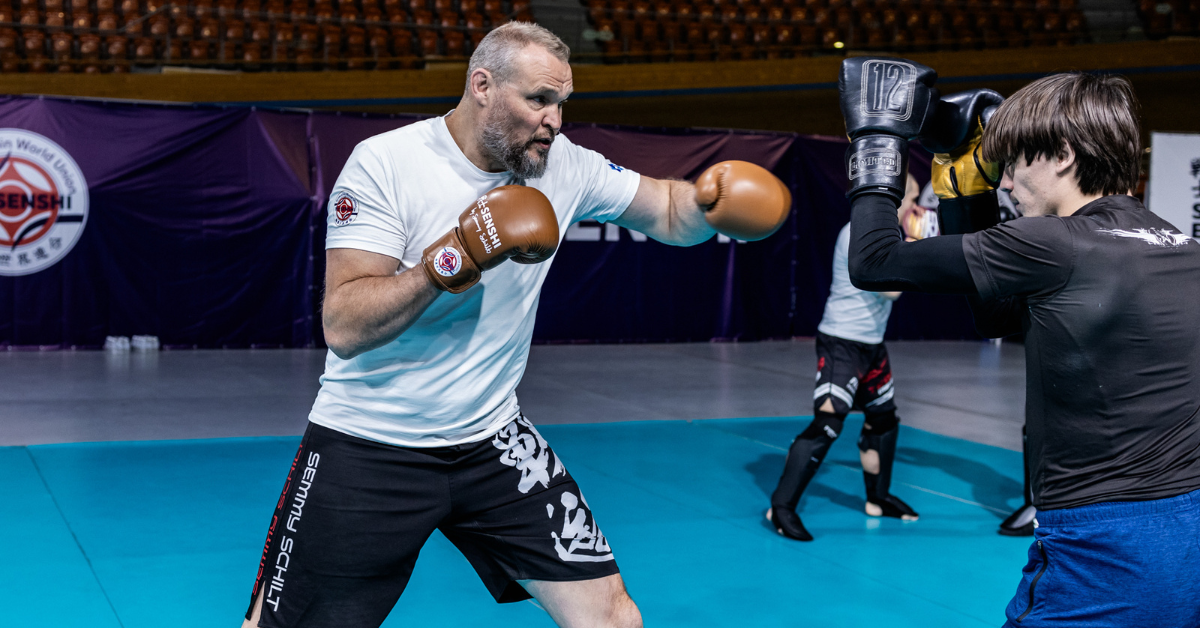
Standing at 2.12 metres, Semmy Schilt doesn’t exactly blend into a crowd. He knows it, too. “You can see I’m big,” he says with a laugh. “You don’t need to tell me that.” The four-time K-1 World Grand Prix champion and President of KWU SENSHI Europe was in Plovdiv ahead of SENSHI 31 Gladiators, and in conversation he turned out to be as self-aware as he was dominant in competition, which is saying something.
Semmy Schilt Talks PANCRASE and Yuki Kondo
Schilt made his professional debut in 1996 inside Pancrase, the Japanese hybrid catch wrestling organisation founded by Masakatsu Funaki that blurred the line between submission wrestling and what the world would eventually call MMA. One of his first opponents there was Yuki Kondo, a scrappy Japanese fighter who went on to compete in over 100 professional bouts across a career stretching from 1996 to 2022.
Their first meeting came at the 1996 Pancrase Neo-Blood Tournament on July 22 of that year, with Kondo winning by split decision. “He was a strong fighter,” Schilt recalls. “He was also upcoming, just like me. We were fighting in the Neo Blood tournament, and in that time I had just come into Pancrase. I think my first, maybe two or three fights I had in Pancrase, and then there was a new blood tournament, which was really great because I could fight in a tournament for the first time.”
Their second bout, at Pancrase Alive 7 on June 30, 1997, went the same way, Kondo winning by unanimous decision. But the rubber match, at Pancrase Breakthrough 10 on November 28, 1999, told a different story: Schilt submitted Kondo with a rear-naked choke in the first round at 2:28. Schilt doesn’t forget the finish. “The next time I fight him, I could make a submission because he walked into it, so I’m really happy for that. But he was a good ground fighter.”
The era itself was unlike anything that came before or since. Pancrase used open-palm strikes rather than closed fists, an approach rooted in catch wrestling and karate, and Schilt brought a striking background that set Dutch fighters apart from the organisation’s Japanese core. “Because I’m coming from karate, and Bas [Rutten] also, our palm strikes are different. We know how to hit. The catch wrestling guys hit with the fingers and it looks tough, but we hit with the palm of the hand, and it’s like, there’s only bone here.” He taps his hand for emphasis. “It’s real power.”
Schilt also spoke about how Pancrase pushed him to grow. He arrived as a karateka and Kudo champion, but ground fighting against opponents like Kondo forced him to adapt fast. “Every time it was a new challenge. First the chance for the ground, then the punching on the ground, and then came kickboxing, because I did not do kickboxing before.” That late transition proved to be the right call. Schilt won four K-1 World Grand Prix titles between 2005 and 2009, becoming the only fighter in K-1 history to win the championship three consecutive times, in 2005, 2006, and 2007, and later added the Glory Heavyweight Grand Slam in 2012.
SENSHI
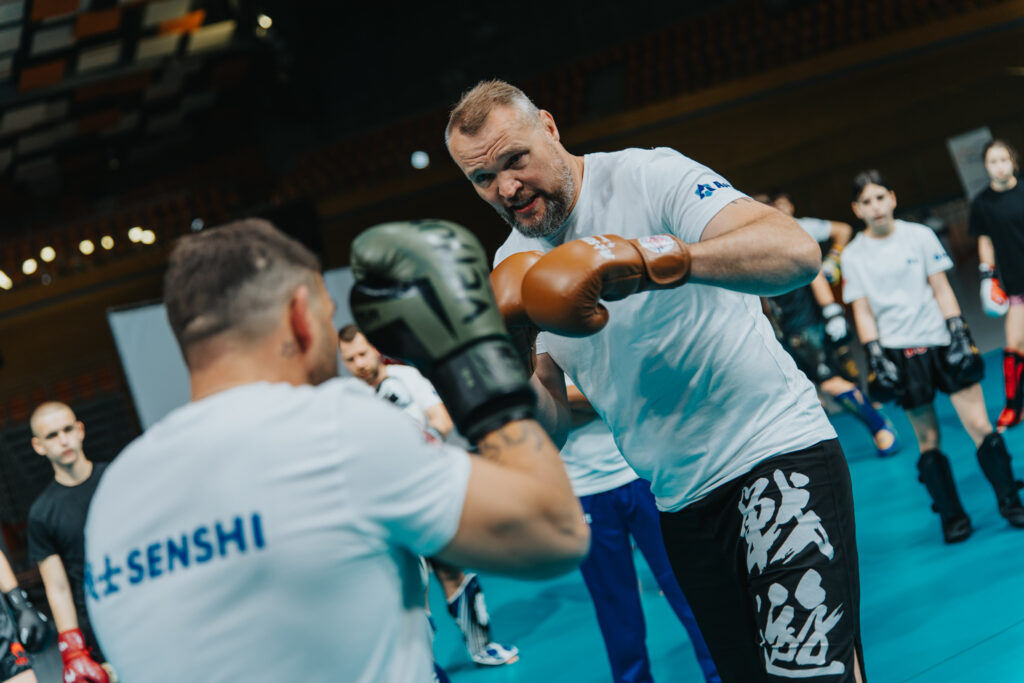
Now he serves as President of KWU SENSHI Europe and holds a 9th Dan in Ashihara karate. Walking around the SENSHI venue, he noticed younger fighters telling him it was the honour of a lifetime to compete in front of him. His reaction was immediate: “It gives me goosebumps.” He sees SENSHI as a natural continuation of everything he built. “Since SENSHI started for me as the transition from karate to kickboxing, from amateur to professional, it’s exactly my path.”
SENSHI 31 Gladiators takes place on May 30 at the Ancient Theatre of Philippopolis in Plovdiv, Bulgaria. The headline attraction is a SENSHI Grand Prix in the 70 kg division, an eight-man knockout tournament where only one fighter walks away with the lightweight championship title. Super fights round out the card, including a 95+ kg clash between Benjamin Adegbuyi and Daniel Dinev.