Ronda Rousey Was Googled 11 Times More Than Conor McGregor Last Weekend – So Who Actually Won?

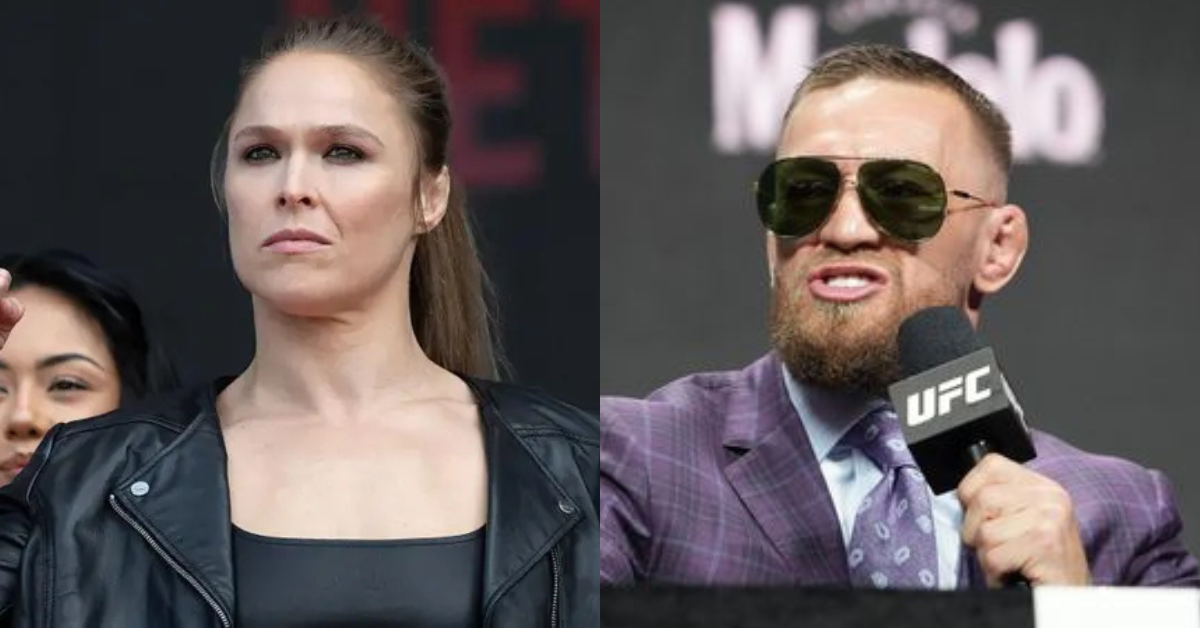
The UFC pulled out their biggest card to play last weekend to counter Ronda Rousey. As Netflix streamed its first-ever live MMA event, the UFC announced the return of Conor McGregor on July 11 at UFC 329 against Max Holloway. It was a deliberate counter-punch. What followed was a weekend-long argument about who actually won the attention war, and the numbers tell a story more complicated than either camp would admit.
On the morning of Sunday, May 18, two stories were fighting for the same audience. One was a 17-second fight on Netflix. The other was a five-year wait that ended with eight words on X. We take a look at some traffic breakdowns from Google Trends.
Ronda Rousey vs. Gina Carano on Netflix
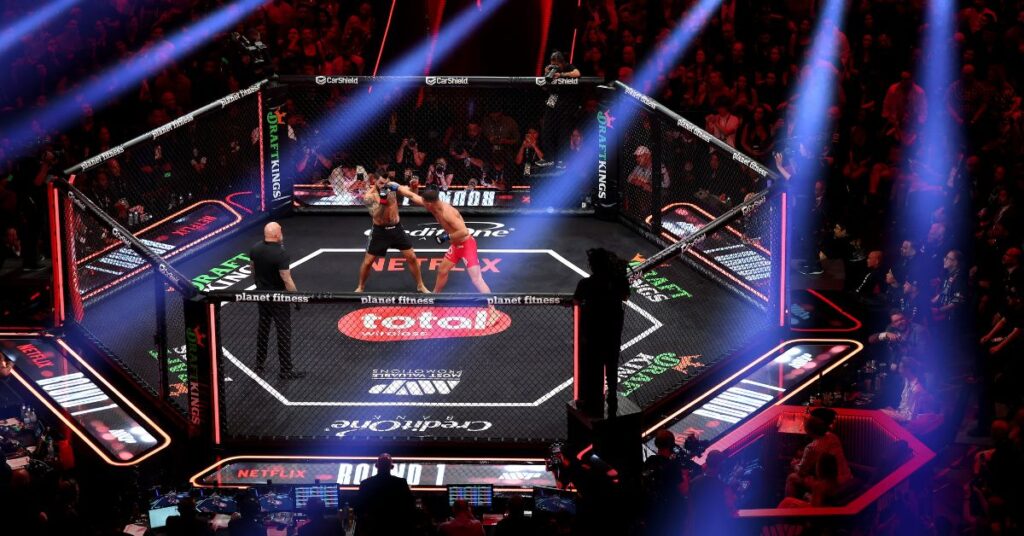
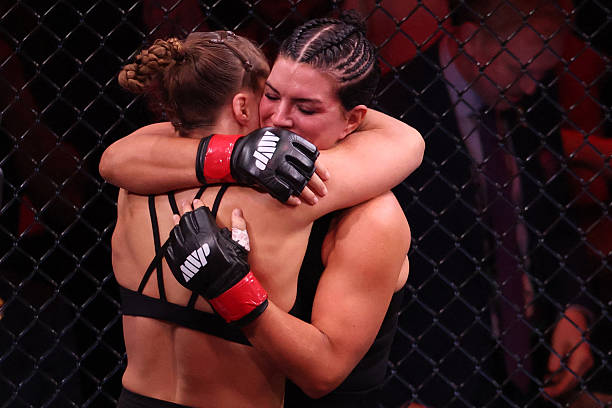
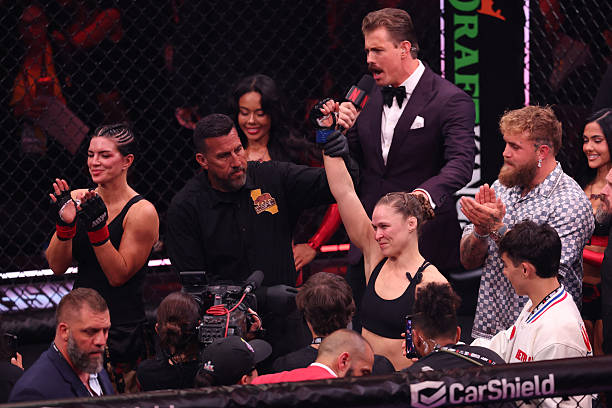
Ronda Rousey returned to MMA on May 16 at the Intuit Dome in Inglewood under the Most Valuable Promotions banner, streaming live on Netflix for 325 million subscribers worldwide. Her opponent was Gina Carano, 44, who had not fought in 17 years. The fight ended in 17 seconds via armbar, with Carano tapping almost immediately after Rousey locked in her trademark submission.
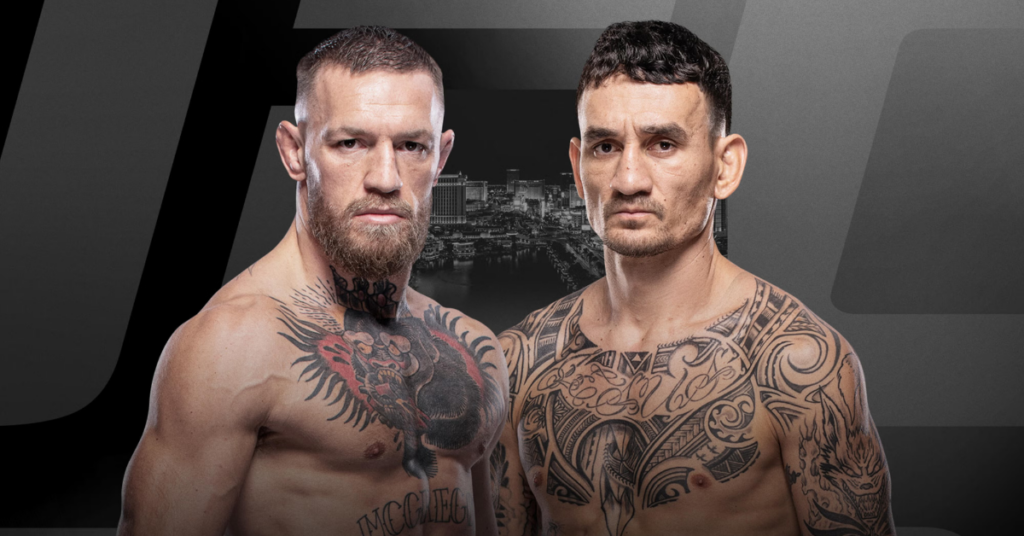
Conor McGregor vs. Max Holloway Announcement
The same evening, the UFC announced, via social media, that Conor McGregor would face Max Holloway at UFC 329 on July 11 in Las Vegas, at T-Mobile Arena during International Fight Week. The timing was deliberate. Jake Paul, who co-owns MVP, called White and the UFC “little insecure boys trying to piggyback off our event” during the post-event press conference.
What Does Google Trends Say?
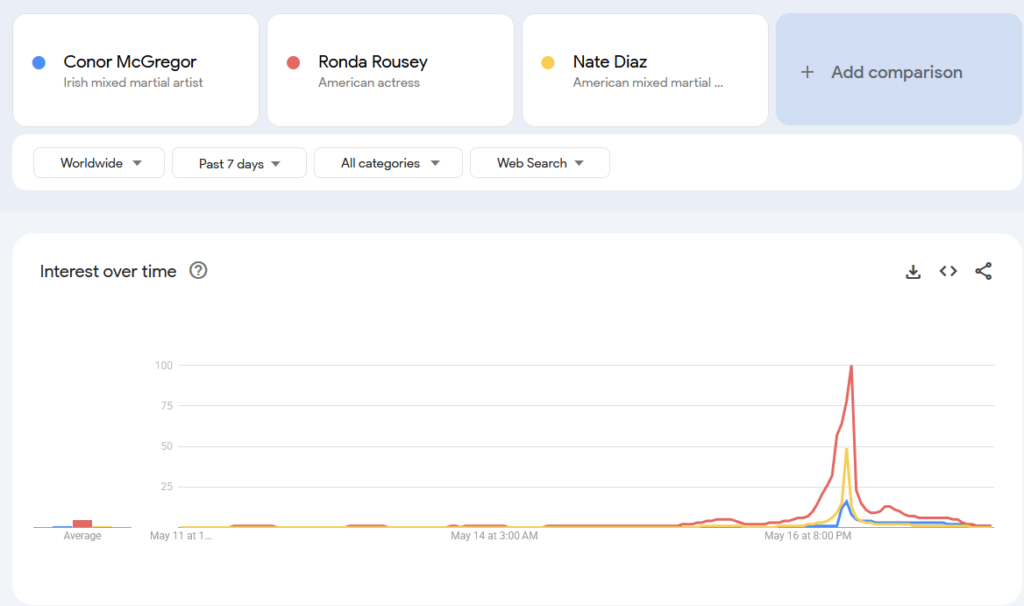
Google Trends data from May 11 through May 18 in the United States shows that Rousey peaked at an indexed value of 100, the maximum, at 4:00 AM UTC on May 17, in the hours immediately after the fight. McGregor peaked at just 9 during that same window. Gina Carano, who has not competed in nearly two decades, peaked at 75. Nate Diaz, whose fight against Mike Perry ran on the same card, peaked at 27.
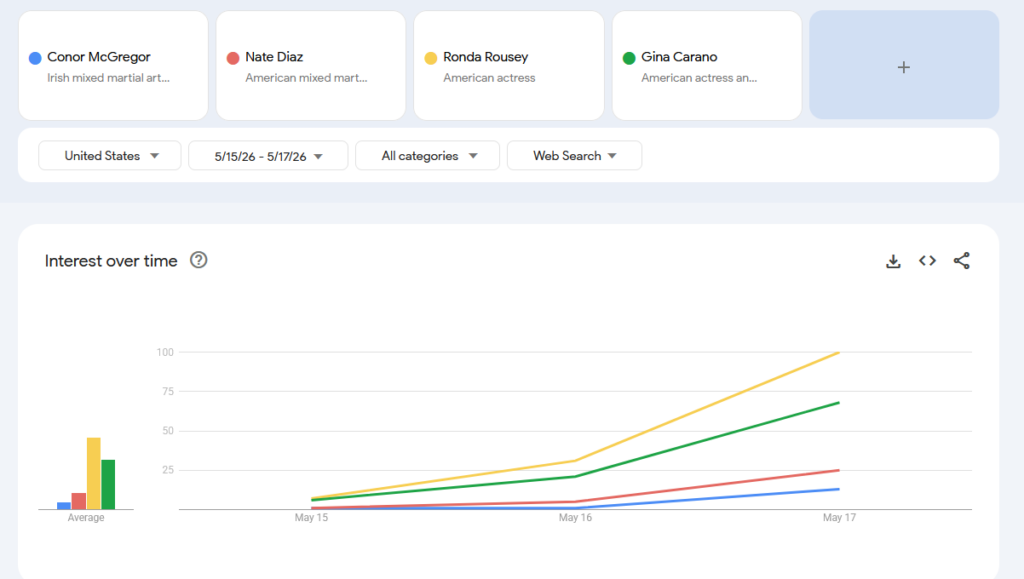
Google Trends measures search interest on a scale of 0 to 100, where 100 represents the peak search volume for a given term within the selected time frame and region. Every other value in the dataset is then expressed as a proportion of that peak. So when Rousey scores 100 and McGregor scores 9 on the same chart during the same window, it means that for every nine searches McGregor received, Rousey received approximately 111.
In a direct geographic split across English-speaking markets, Rousey commanded 89% of the combined search share between her and McGregor in both the US and Canada, 81% in Australia and South Africa, and 77% in the UK. McGregor’s search share was strongest in Tajikistan (83%), Turkmenistan (84%), and his home country of Ireland, where the split was still in Rousey’s favour at 53% to 47%.
The rising query data offers useful context. The top breakout search within McGregor’s own Google Trends panel was “Conor McGregor vs Max Holloway tickets,” up over 4,900%. The queries “Rousey vs Carano” and “Ronda Rousey vs Gina Carano” also appeared inside McGregor’s rising terms at +1,200% and +1,150% respectively, meaning even people who started searching for McGregor ended up searching for the MVP event.
Rousey‘s event drove active search, people looking things up, wanting answers, checking results. McGregor’s announcement travelled through passive consumption: ESPN push alerts, viral posts on X, news banners. Both mechanisms generate reach, but one converts into measurable Google traffic and one does not, which is why McGregor’s search numbers look so weak despite his announcement saturating media coverage from the BBC to Al Jazeera and beyond.
Social Media
On social media, the picture tilts toward McGregor. He broke his silence on X with the post “you’re gonna respect on my motherf***ing name,” which spread rapidly alongside Holloway’s promotional video response. UFC 329 was trending on Google on May 17, though Rousey’s search volume still far outpaced it in absolute terms.
So who won the weekend? On search volume, it is Rousey by a significant margin, 11 times McGregor’s peak in the US, with nearly every MVP fighter beating him individually. On media coverage and social conversation, McGregor’s announcement was the story that major outlets led with on Sunday morning. On business momentum, the picture is less clear for both sides: Rousey left the cage for the last time, MVP still has no confirmed viewership figure, and McGregor’s UFC return is set for a July 11 pay-per-view on Paramount+ that has five years of anticipation behind it.
Who won the weekend?
On Twitter, Dave Meltzer explained his findings:
“Rousey vs. Carano for some reason was listed as a movie and not a TV show on Netflix and first day was No. 6 in the world in that category which is a bigger category than TV shows. Keep in mind main event started after midnight Eastern. It beat a big WWE show. Unclear about any records but doesn’t appear to be gigantic although was No. 1 in US, Canada, Mexico in movies which is substantial viewership. UFC did its record low on Paramount 13% below what a show like this would normally do.”
What the data collectively points to is a market divided by platform and by generation. Netflix drew a casual, mainstream audience, people who do not follow MMA week-to-week but turned on the app because Ronda Rousey’s name still means something outside the sport. That is high-volume, curiosity-driven queries from people who needed to look up who Gina Carano is, and what time the fight started.
McGregor’s audience, on the other hand, already knew. His fans did not need to Google him, they were already on X watching him go back and forth with Holloway within minutes of the announcement.
The weekend is probably best described as a split decision. Rousey won the search. McGregor won the broadcast news cycle and social media.